
Query Loop
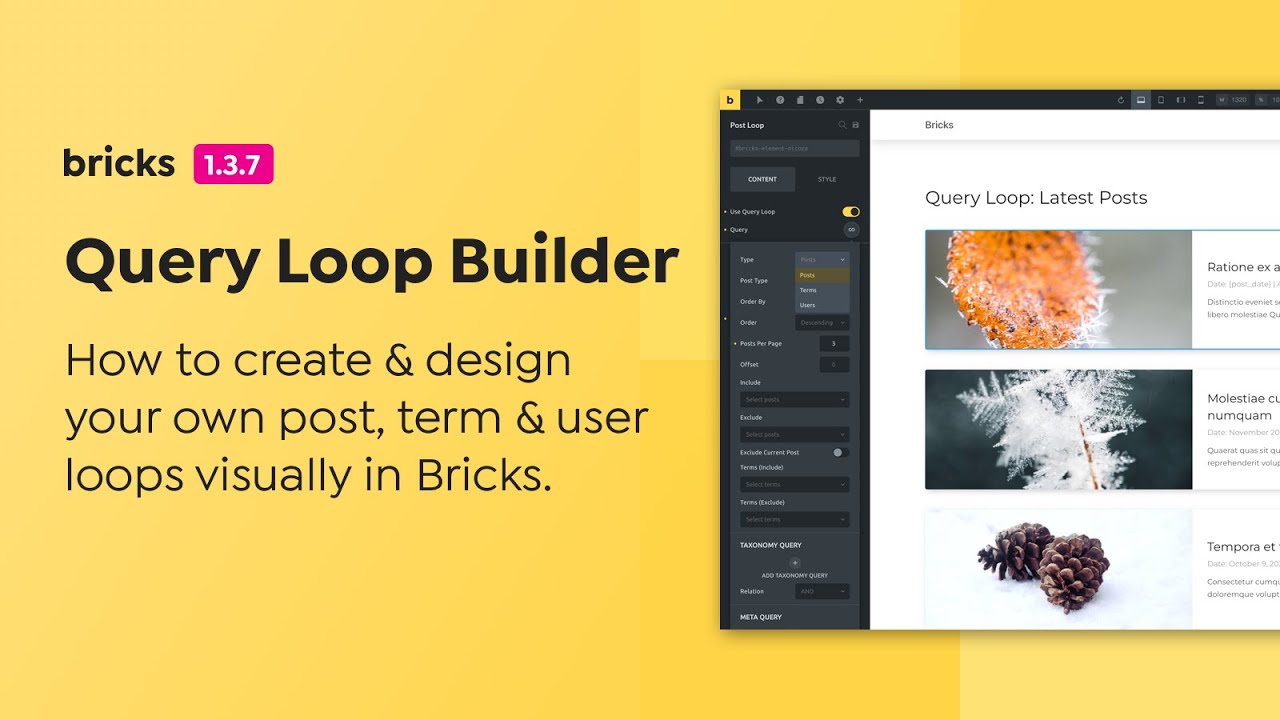
The Query Loop builder is available for layout elements such as Container, Section, Block, and Div. It is also available on the classic Accordion and Slider elements.
The Map element has its own query loop controls for dynamic addresses. Nestable elements such as Accordion (Nestable), Tabs (Nestable), and Slider (Nestable) use their own child repeaters, so they do not expose the same full Query Loop control as layout elements.
It lets you query content and render each result through the same design. Everything inside the loop can use dynamic data from the current result.
Dynamic data in nested loops
Section titled “Dynamic data in nested loops”Dynamic data uses the current loop result. In a nested loop, the inner result becomes the current result for elements inside that loop.
For example, {term_name} can return the current term in an outer Terms loop. Inside a nested Posts or Media loop, the current result is a post or attachment, so the same term tag does not read the outer term.
Bricks does not provide parent-loop syntax for output tags. Keep values that belong to the parent result outside the inner loop when possible. Inner query controls can use dynamic data while Bricks is building that nested query, but output inside the inner loop still resolves against the inner result. Accessing the parent result from inner-loop markup requires custom PHP or a custom dynamic data tag.
You can query post types, taxonomy terms, users, API responses, and arrays. Some typical use cases are:
- Posts: Latest posts, related posts (works for any registered & public post type)
- Terms: Post categories & tags, product categories, etc.
- Users: List blog authors, community members, and team members
- API: Render items from an external JSON API
- Array: Render items from a PHP or JSON-style array
Important
Section titled “Important”Bricks Query Loop automatically generates HTML comments such as <!--brx-loop-start-abc123--> on the frontend. These comments are essential for features like AJAX Pagination, Query Filters, Load More, and Infinite Scroll to function correctly.
Some performance optimization plugins may remove all HTML comments by default. If you are using such a plugin, ensure that Bricks-generated comments are preserved to avoid breaking dynamic query functionality.
How to create a query loop
Section titled “How to create a query loop”Add a “Container” element to the canvas. Enable the Use Query Loop setting to turn your container into a loop (repeater) item.
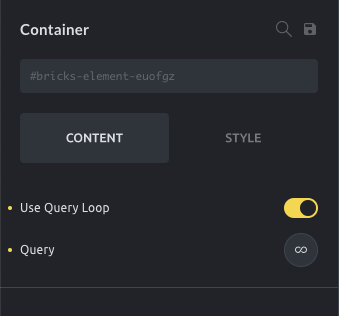
Container element: new query loop control
Once you’ve enabled the Use Query Loop setting, you’ll see a Query control (loop/infinity icon).
Open the query control to set the query parameters for retrieving the content from your database.
This container now serves as your repeater item. All elements inside this container are repeated as often as there are query results.
Query control
Section titled “Query control”The Query control supports five built-in query types: posts, terms, users, api, and array.
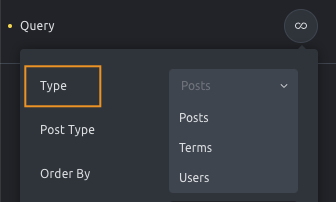
- Posts enable a WP_Query type of query. This is the default query type and should be used when you want to display a loop of posts, pages, media files, or custom post types.
- Terms enable the WP_Term_Query. This should be used when you want to loop through the different terms of a taxonomy. Useful to list all the product categories that contain products.
- Users enable the WP_User_Query. This should be used when you want to loop through a set of site users. Useful to list the blog authors or a list of team members (as long as they are inserted as site users).
- API lets you render items returned by an external API. See Query data from APIs for the full API query workflow.
- Array lets you render items from PHP or JSON-style array data. See Query Type: Array below.
The query controls adapt according to the selected query type.
ACF Repeater source context
Section titled “ACF Repeater source context”An ACF Repeater query uses the active post or query context to retrieve its rows. If the repeater field is assigned to an ACF Options Page, Bricks retrieves the rows from that options page instead.
Selecting an ACF Repeater query does not store or provide a control for an arbitrary source post or page ID. For repeatable data shared across pages, assign the field to an ACF Options Page. To retrieve rows from a specific different post or page, use custom PHP or a custom query or dynamic-data solution that passes the required ACF source post ID. See Dynamic Data for ACF field support in Bricks.
Query editor (PHP)
Section titled “Query editor (PHP)”Bricks 1.9.1 introduces a new Query editor control that lets you write your own queries in PHP for maximum flexibility and querying capabilities.
The query editor appears after enabling the “Query editor (PHP)” control.
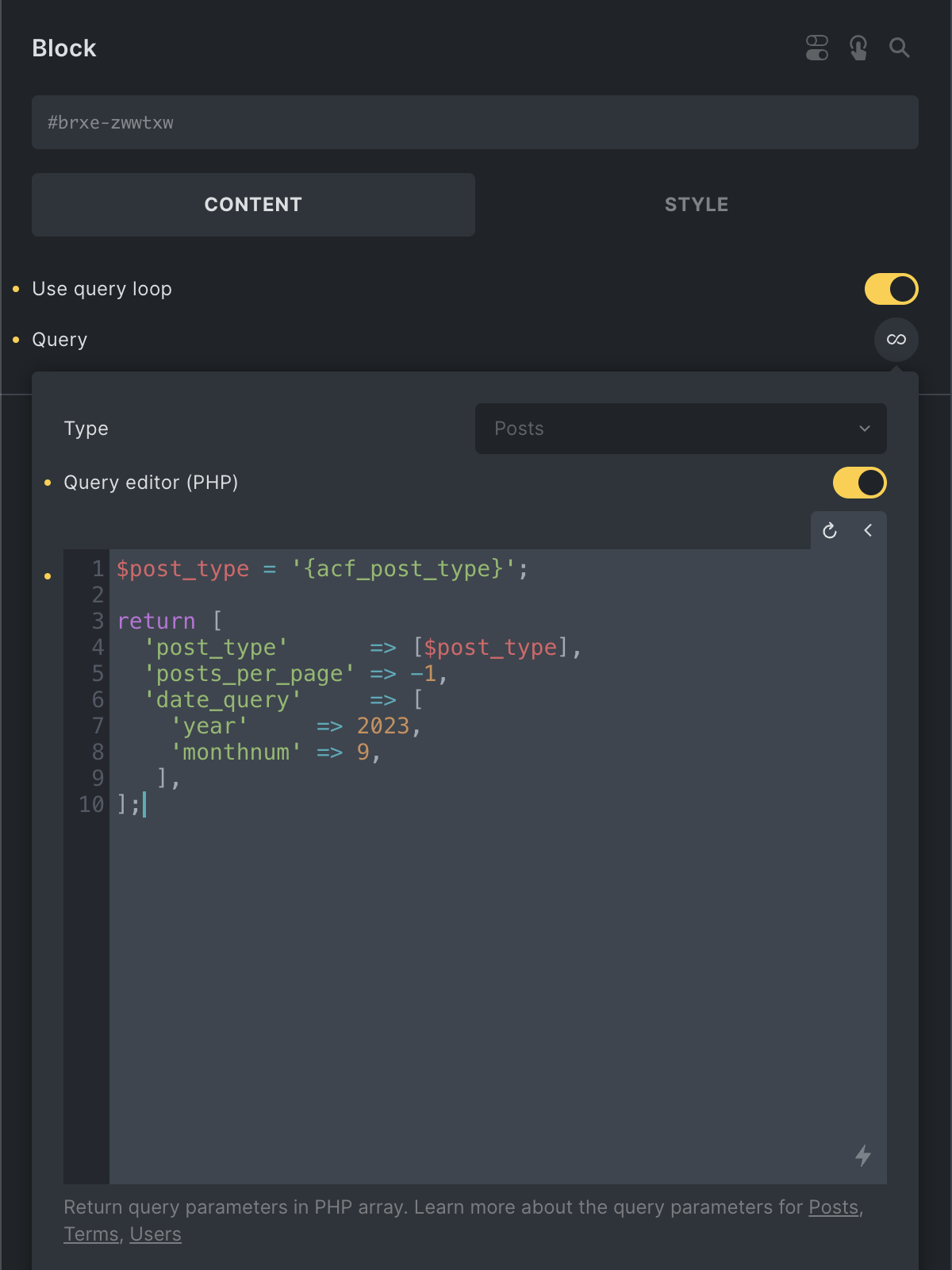
Custom query using dynamic data (ACF) for the post type, returning all posts for September 2023.
You have to return a PHP array containing the WordPress query arguments you’d like to use for your query.
As shown in the screenshot above, the query editor supports dynamic data.
Bricks signs Query editor code. If the signature is missing or invalid, Bricks will not run the code. Keep the returned array focused on query arguments. Do not echo output or run unrelated database writes inside a Query editor.
Posts query
Section titled “Posts query”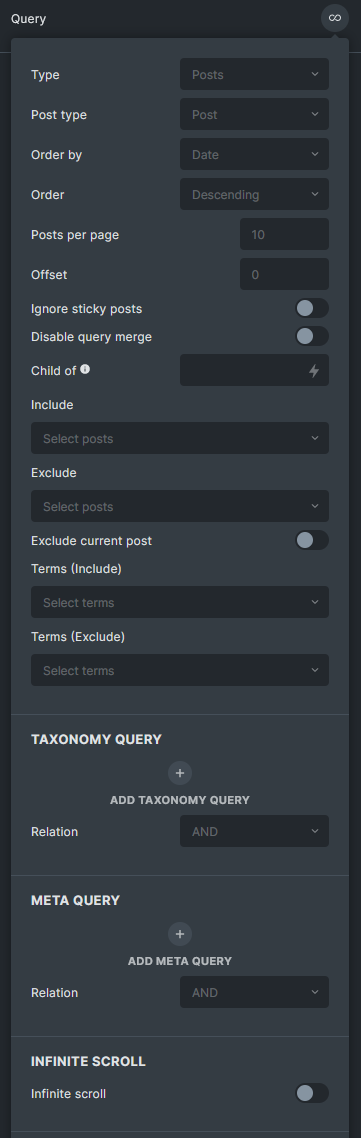
Post type: Select one or multiple post types (default: posts)
Order by: Order the results by post ID, author, title, published or modified date, comment count, relevance, menu order, or random (default: published date). (Support multiple values @since 1.11.1)
Order: Ascending or Descending (default). (Support multiple values @since 1.11.1)
Posts Per Page: The number of posts to show per page (default: WordPress settings > Reading > Blog pages show at most)
Offset: The number of posts to skip.
Ignore Sticky Posts: Turn this on if do not want to move sticky posts to the start of the set.
Disable Query Merge: Turn this on if do not want the query to be auto-merged by Bricks in archive pages, search pages, etc. Usually, you will turn this on for the Query loops in the footer, header, or non-main query. This is the GUI for the bricks/posts/merge_query filter.
Child Of: Set the parent ID to return all its children only. (post_parent in WP_Query)
Include/Exclude: Include or exclude one or multiple posts from the query. These controls support dynamic data (@since 1.12).
Include authors / Exclude authors: Include or exclude posts by author. Select users manually, or use supported dynamic data tags to pass author IDs (@since 2.4).
Exclude Current Post: If enabled it will exclude the current post from the loop (useful to build a “related posts” section)
Terms Include/Exclude: Include or Exclude posts that have one or multiple terms.
Taxonomy Query: Add one or multiple taxonomy queries to filter the posts.
Tax Query Relation: Define if the taxonomy queries should be inclusive (OR) or exclusive (AND).
Meta Query: Add one or multiple meta queries to filter the posts based on the custom fields.
ACF date fields in a meta query
Section titled “ACF date fields in a meta query”A meta query compares the value stored in the WordPress database. It does not compare the formatted value shown by an ACF field or a rendered dynamic data tag.
For an ACF Date Picker field, use the field name as the meta key, without braces or an acf_ prefix. ACF stores this field as Ymd, regardless of its return or display format. To return upcoming posts, for example, use:
- Meta key:
event_date - Meta value:
{current_wp_date:Ymd} - Compare:
>= - Type:
NUMERIC
Use {current_date:Ymd} instead when the comparison should use UTC rather than the WordPress site timezone.
ACF Date Time Picker values are stored as Y-m-d H:i:s. Use a value such as {current_wp_date:Y-m-d H:i:s} with Type set to DATETIME.
Fields inside an ACF Group normally use the stored parent_child meta key. You can keep any return or display format needed on the frontend because it does not change the raw value used by the query.
Relation: Define if the meta queries should be inclusive (OR) or exclusive (AND).
No Found Rows: Improve performance when the loop does not need pagination, result counts, or max page counts.
Disable update_post_meta_cache and Disable update_post_term_cache: Performance options for post queries that do not need post meta or term cache data.
Random seed TTL: Duration in minutes for which the random seed exists. Set to prevent duplicate post results (only needed & available when using a random order query loop). Set “0” to turn this feature off.
If you set the TTL to 10 minutes, the query result remains the same for the next 10 minutes. This ensures that no duplicate posts are displayed on different pages or when the infinite scroll is active. (@since 1.7.1)
Is main query (Archive, Search): When creating an archive or search template, choose one of the loops as the main query. This will prevent a 404 error from occurring when visitors navigate to different pages. Turn on to designate the main query. Remember to set the correct query on your pagination element as well.
However, do not turn on this option for multiple queries on the same page, as only the first one will be set as the archive main query. (@since 1.8)
Enhanced Ordering Options
Section titled “Enhanced Ordering Options”Starting with version 1.11.1, the Order By and Order settings in Bricks Query Loop have been improved to support multiple ordering criteria. This allows you to define complex ordering rules directly within Bricks, eliminating the need for a custom PHP filter that was previously required.
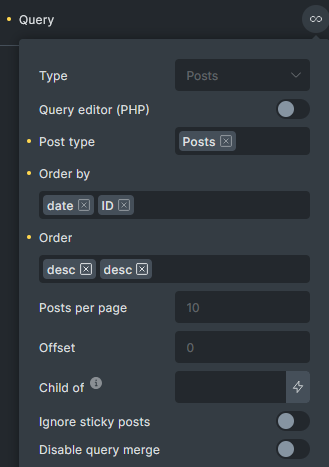
This update is particularly useful in scenarios where you want to order query results by more than one criterion. For example, you can now order by name in descending order and then by ID in descending order. Bricks will process these criteria sequentially, applying each in the order specified to deliver the desired result.
Example Scenarios:
- Multi-Criteria Ordering: Suppose you have a directory listing and want to display results by popularity first (custom field) and then by date added. With this update, you can set the query to order first by the popularity meta field in descending order and then by date added in ascending order, ensuring that the most popular and newest items appear at the top.
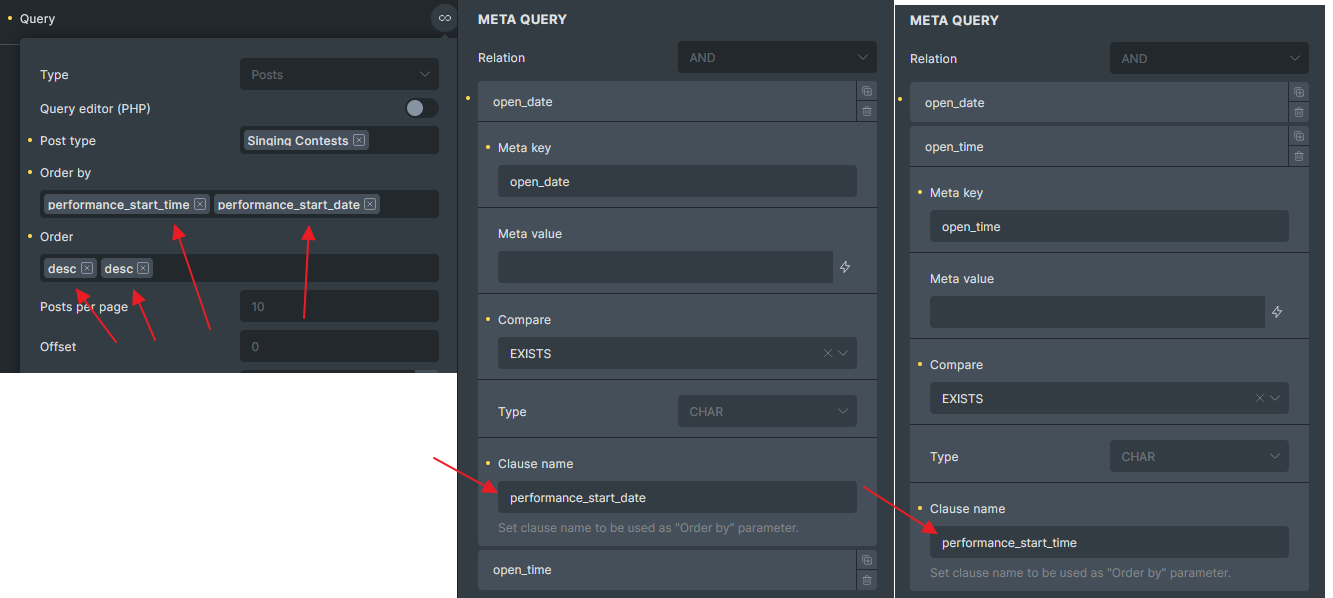
- Custom Order Clauses with Meta Queries: Bricks now supports more complex ordering directly aligned with meta query conditions. For instance, if you’re working with a meta query to order posts by performance date and time, you can define this directly in the order clause. Code example in this article.
Best Practice for Pagination & Order By
Section titled “Best Practice for Pagination & Order By”When using multiple ordering criteria, include ID as a secondary ordering criterion to avoid duplicate results across paginated pages. For example, if you’re displaying 5 posts per page and have 15 posts with the same price, ordering by price alone may cause posts to appear on multiple pages. Set the query to order by price in ascending or descending order, followed by ID in ascending or descending order.
Example 1: Latest Posts
Section titled “Example 1: Latest Posts”In this example, we’ll list the latest four posts (each item shows the featured image, post title, and excerpt) using the Query Loop Builder.
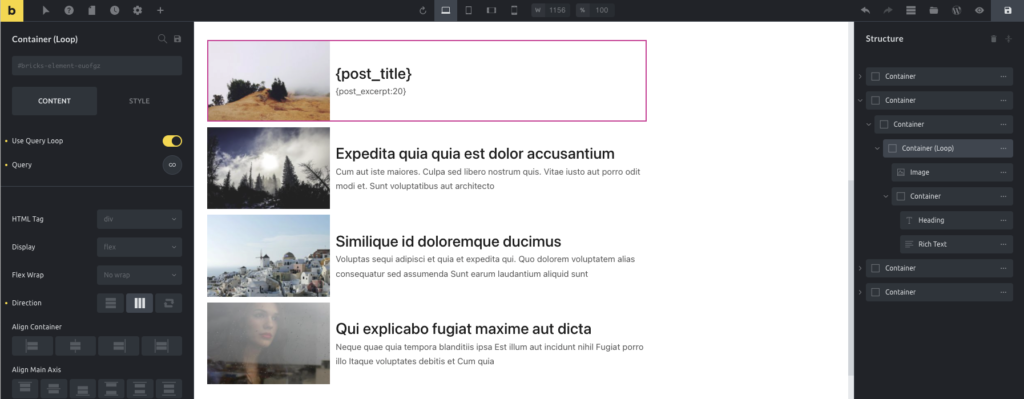
Display the latest posts using a custom query loop
We start by adding a container to the canvas. This container holds our loop and serves as the blueprint for each query item.
Next, we enable the “Use Query Loop” setting to turn our simple container into a query loop.
We add an image element inside our container and set it to “Featured Image” using the Dynamic Data dropdown.
Add another container with a Heading and Text element in the same container.
For the Heading element, we add the {post_title} tag.
For the Text element, we add {post_excerpt} tag.
You could use the Post Title element or the Post Excerpt element instead if you like.
By default, the query control shows the latest posts. But because we want to restrict the number of posts shown, we need to edit the Query setting and set the Posts Per Page control to 4 to restrict the output to four rows.
Media query
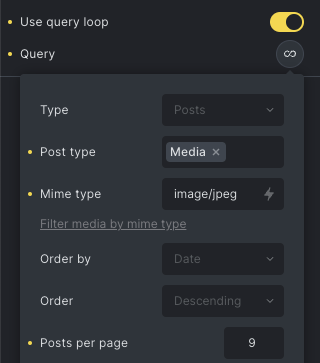
Section titled “Media query”Bricks 1.5 introduces the possibility to query for media files (the attachment post type). You’ll now find the Media (attachment) post type in the Posts query type.
After selecting Media in the post type control, you’ll get a new control to define the mime type. By default, Bricks automatically queries for images, but you may define other mime types (separated by a comma, e.g., image/jpeg,image/png,image/gif).
To query for the images attached to a post, you may use the Child of control to specify the post ID. To do it dynamically, you may use dynamic data to fetch the current post id: {post_id}.
Example 2: Media gallery
Section titled “Example 2: Media gallery”The media query opens the possibility of building a custom media gallery using the Query Loop builder. To start, you need to add a Container element, insert a Block element inside it, and finally, an image element inside of the Block.
In the container, you’ll set the flex-wrap to wrap and the direction to horizontal (row). In the Block, you must activate the Query Loop and set the Media post type and the number of images you’ll want to get (posts per page). In the Block layout, you must set the width and the height (e.g. 300px).
In the Image, you’ll set the dynamic data as {post_id} - note that the query returns the attachment posts (media files), so the image ID is the post ID. To complete the layout, set the image object-fit to cover and the height to 300px.
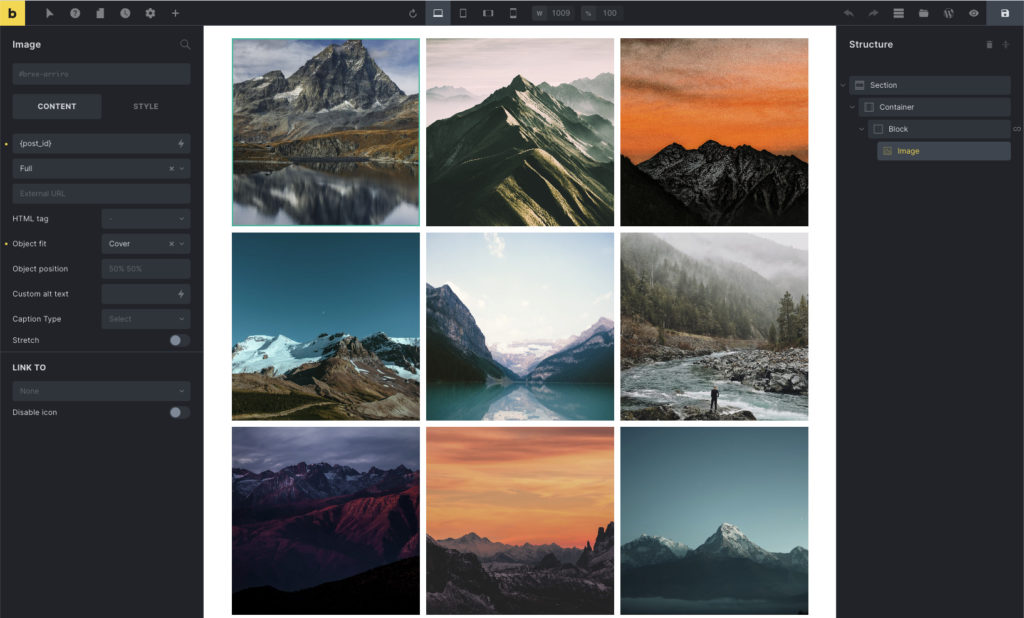
The final result of a media gallery using the Query Loop builder
WooCommerce Products Query
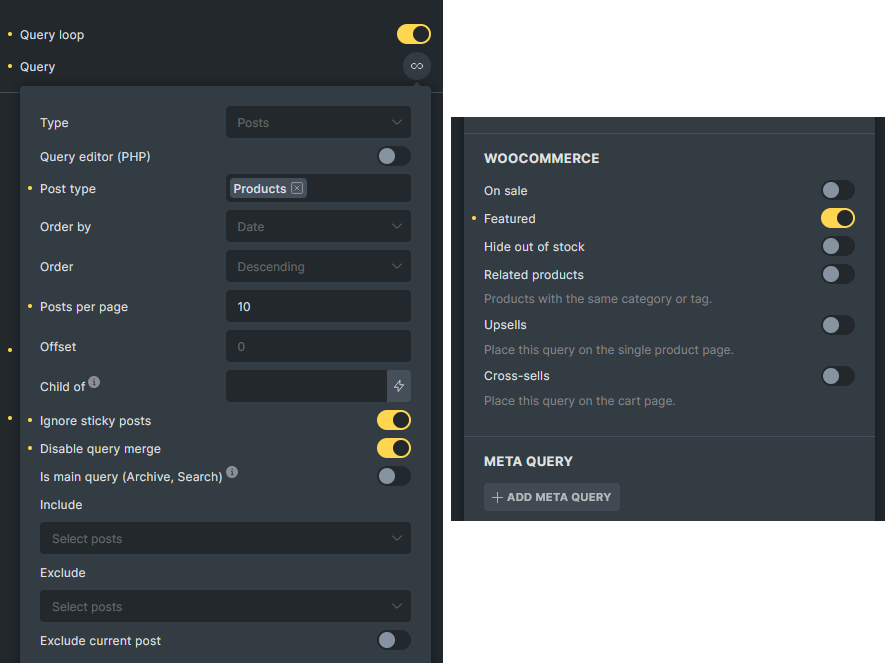
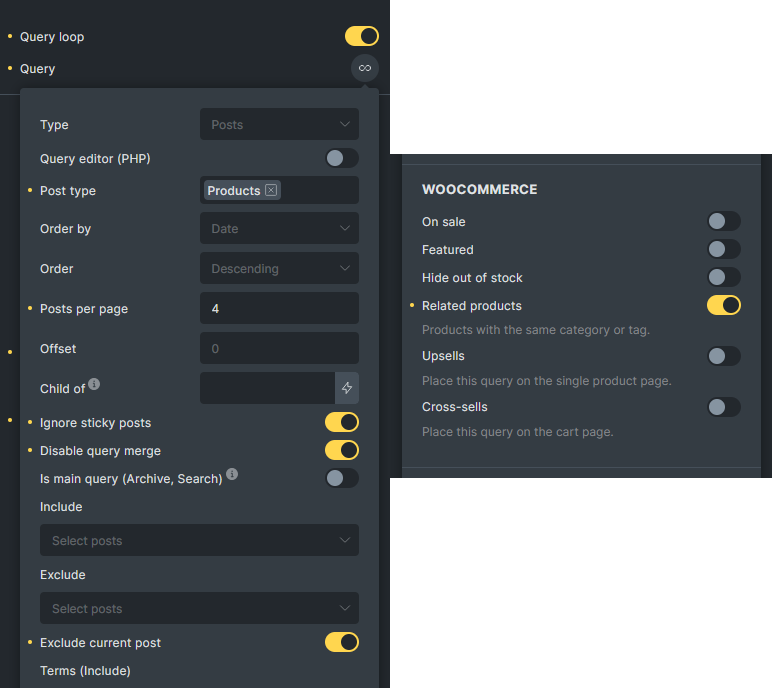
Section titled “WooCommerce Products Query”Since 1.10, Bricks introduced new settings for WooCommerce products query. Once selected Products post type, you will be able to see the WooCommerce section. (Only available if WooCommerce is activated)
Example 1: WooCommerce Featured Products
Section titled “Example 1: WooCommerce Featured Products”To show latest 10 featured products on your homepage, just set a query loop with below settings.
Example 2: WooCommerce Related Products
Section titled “Example 2: WooCommerce Related Products”To show 4 related products on your single product template.
Example 3: WooCommerce Upsells Products
Section titled “Example 3: WooCommerce Upsells Products”To show 3 upsells product in a single product template.
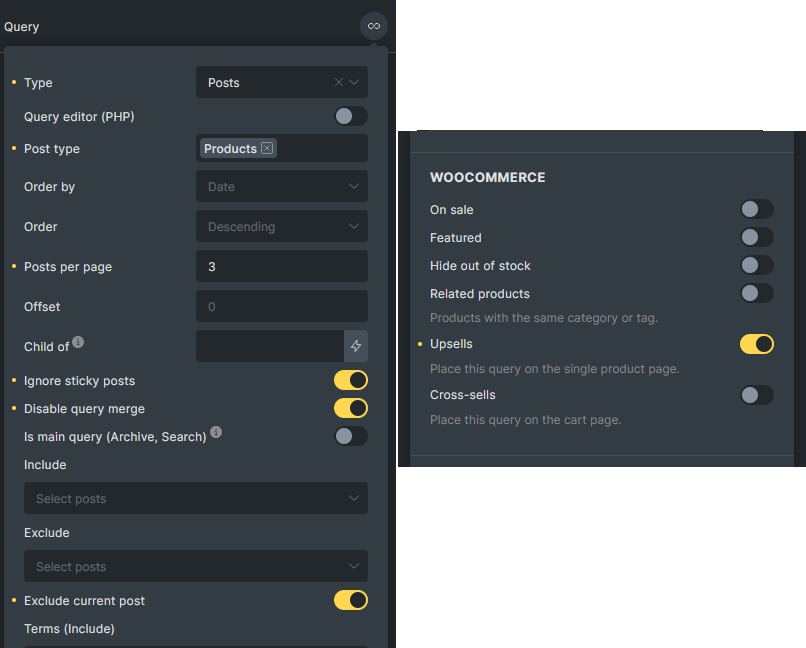
WooCommerce v2 query loops
Section titled “WooCommerce v2 query loops”Bricks 2.4 adds WooCommerce query loops for advanced modular Cart, Checkout, and My Account layouts.
These loops cover cart coupons, fees, taxes, order items, order totals, order downloads, customer notes, account orders, account order actions, account downloads, and account addresses.
Advanced v2 query loops require Bricks > Settings > WooCommerce > Enable advanced modular elements. See WooCommerce v2 query loops and dynamic tags for the complete list and matching dynamic tags.
Terms query
Section titled “Terms query”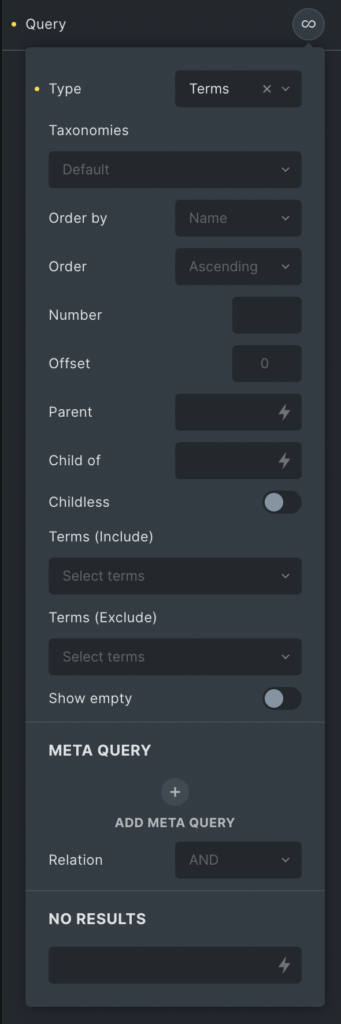
Taxonomies: Select one or multiple taxonomies to query (default: none).
Order by: Order the results by term ID, term name, term parent, count, or include list.
Order: Ascending (default) or Descending.
Number: The number of terms to show per page. WordPress default is all, but Bricks defaults to the number defined in the WordPress settings > Reading > Blog pages show at most. Use 0 to display all the results.
Offset: The number of terms to skip.
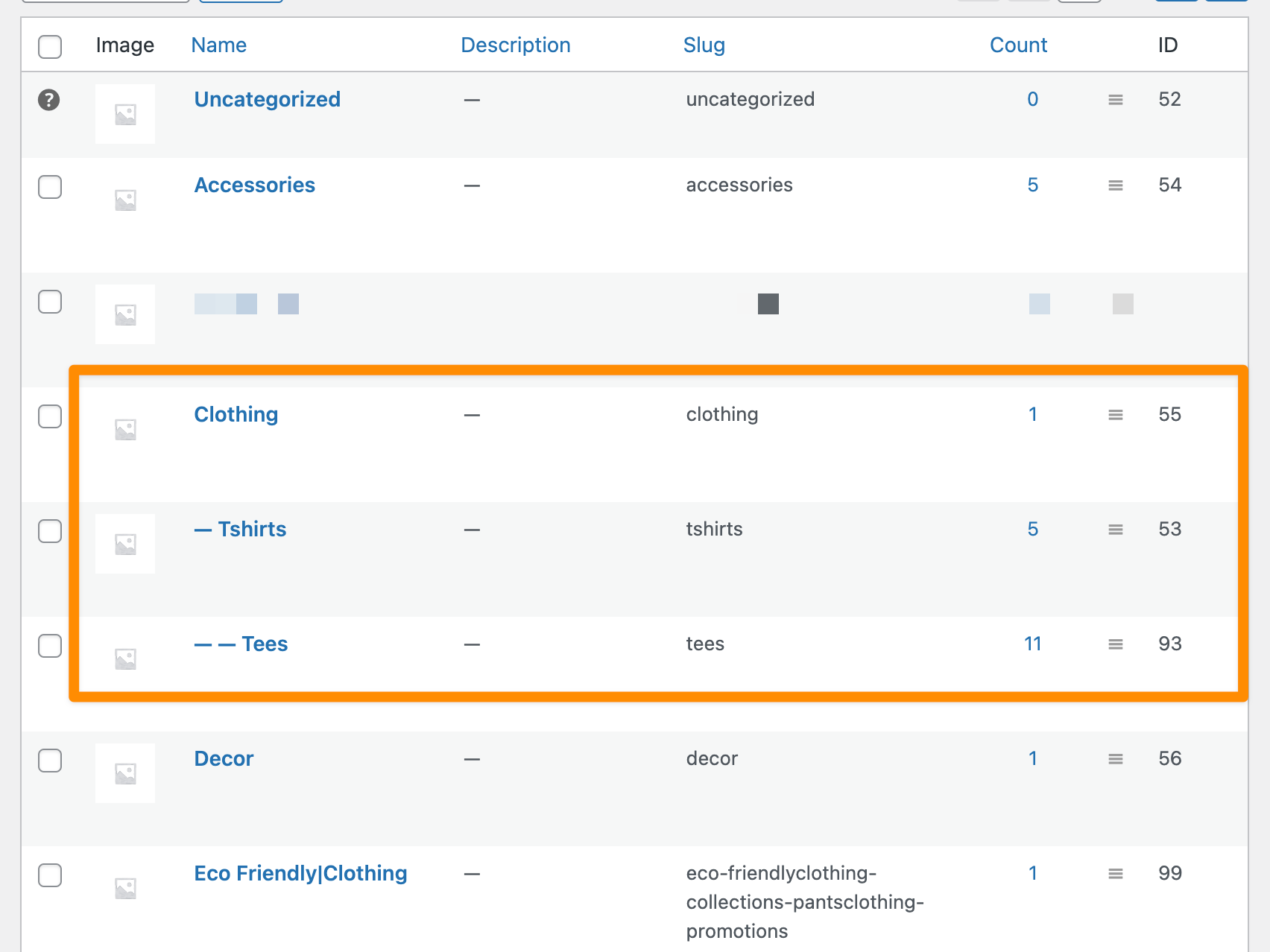
Parent: Parent term ID to retrieve direct-child terms. Set this to 0 to fetch only the terms that have children. Ex.: Given this structure, entering 55 would get only the T-shirts.
Child of: Term ID to retrieve child terms of. Ex.: Given this structure, entering 55 would get T-shirts and Tees.
Childless: (bool) True to limit results to terms with no children. This parameter has no effect on non-hierarchical taxonomies. Default false.
Disable Query Merge: Turn this on if do not want the query to be auto-merged by Bricks. (@since 1.7.1)
Terms Include/Exclude: Include or Exclude terms from the query
Show empty: Whether to show terms not assigned to any posts.
Meta Query: Add one or multiple meta queries to filter the posts based on the custom fields.
Relation: Define if the meta queries should be inclusive (OR) or exclusive (AND).
No Results: Text to be shown when there are no matching results.
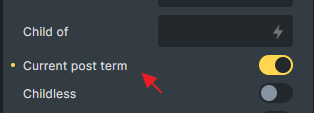
Current post term: Enable to get the terms assigned to the current post only. (@since 1.8.4) Only use in single post context. Only visible if “Type” is set to “Term”. This is the same logic as the example in bricks/terms/query_vars
Example 3: Product categories
Section titled “Example 3: Product categories”In this example, we’ll build a dynamic list of product categories (product category image + a link to the category archive).
The example is based on the WooCommerce plugin and the sample products. We’ll need one container to hold the container loop. Inside the container loop, we’ve added a Basic Text element that contains the Dynamic Data {term_name} tag.
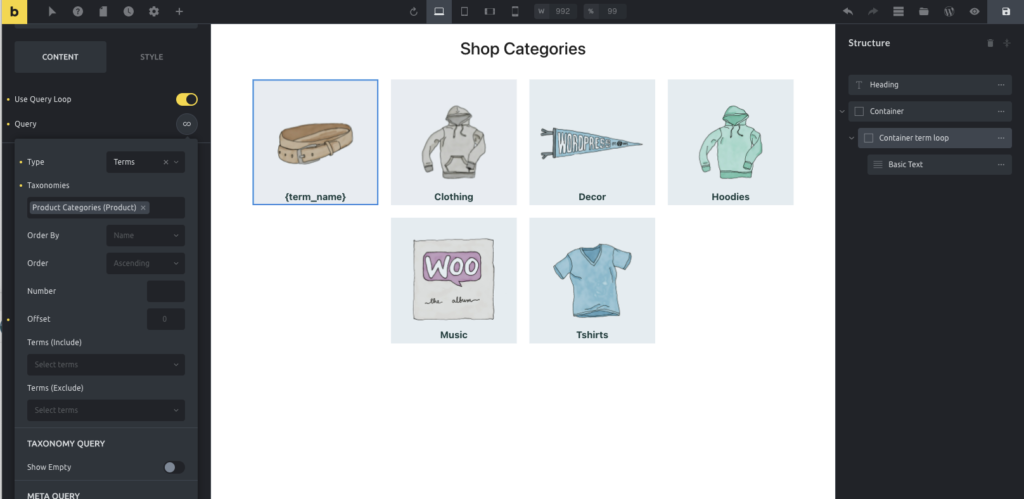
Display the product categories with a link
After setting the Query to loop through “terms” and selecting the Taxonomy “Product Categories”, you’ll get in the canvas as many containers as the existing categories. Inside the loop, you’ll be able to use several dynamic data tags to fetch the term’s data, such as the term ID, the term name, the term archive URL, the term description, and any term meta.
In this example, we set the loop container background image as the product category thumbnail, using the Dynamic Data dropdown and selecting the Product Category Image tag:
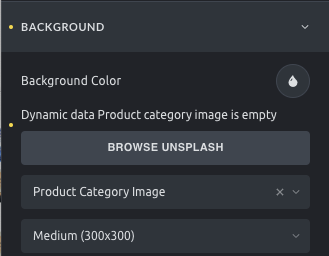
Set the container background image
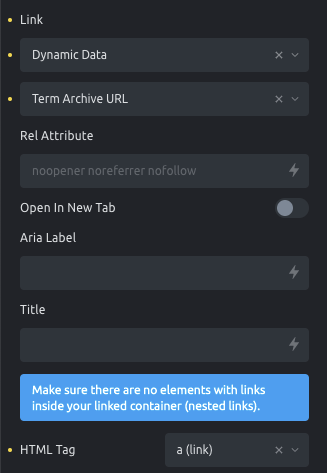
We also set the loop container as a link to the product category archive page (using the Term Archive URL dynamic data tag). You’ll need to set the HTML tag to “a (link)” and the link type to Dynamic Data, which will enable the Dynamic Data dropdown:
Users query
Section titled “Users query”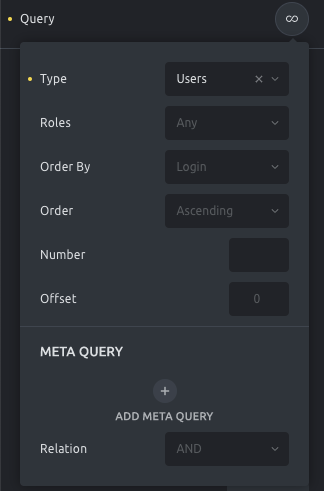
Roles: Select one or multiple user roles to query (default: any)
Order by: Order the results by user ID, name, username, nicename, login, email, registered date, post count, or include list.
Order: Ascending (default) or Descending.
Number: The number of users to show per page. WordPress defaults to all, but Bricks defaults to the number defined in the WordPress settings > Reading > Blog pages show at most. Use -1 to display all the results.
Offset: The number of users to skip.
Current post author: Enable to query the current post author (@since 1.9.1)
Disable Query Merge: Turn this on if do not want the query to be auto-merged by Bricks. (@since 1.7.1)
Meta Query: Add one or multiple meta queries to filter the posts based on the custom fields.
Relation: Define if the meta queries should be inclusive (OR) or exclusive (AND).
No Results: Text to be shown when there are no matching results.
Example 4: The blog authors
Section titled “Example 4: The blog authors”In this example, we want to build a section to list all the blog authors.
The blog authors are website users with the role of author. As in the other examples, we’ve used a container to loop through the users. In that container, we’ve set a query of user type, setting roles to “Author” to pull only the website’s authors.
We’ve added an Image and a Basic Text element inside the query loop container.
The image we’ve set to display an ACF Dynamic Data field containing the profile image.
In the Basic Text, we’ve used the Dynamic Data {wp_user_display_name} tag.
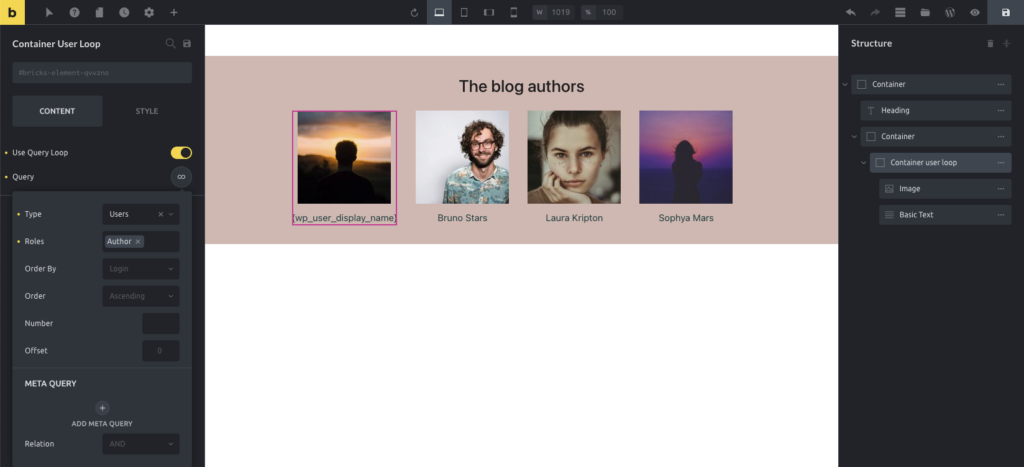
Display the blog authors
The Pagination element
Section titled “The Pagination element”The perfect companion to the custom query loop builder. You’ll find the Pagination element under the WordPress group of the elements panel.
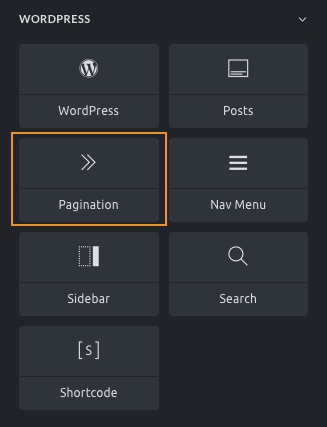
Having pagination as a separate element offers you the most flexibility to build any layout.
After adding the Pagination element to the canvas, you’ll need to link this pagination element to one of the elements that run a query. To do so, please select the element in the Related Query control by editing the Pagination element:
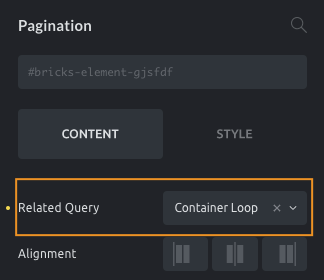
Tip: to make it easier to recognize elements, give descriptive element names to the containers that have a query enabled.
Load more (button)
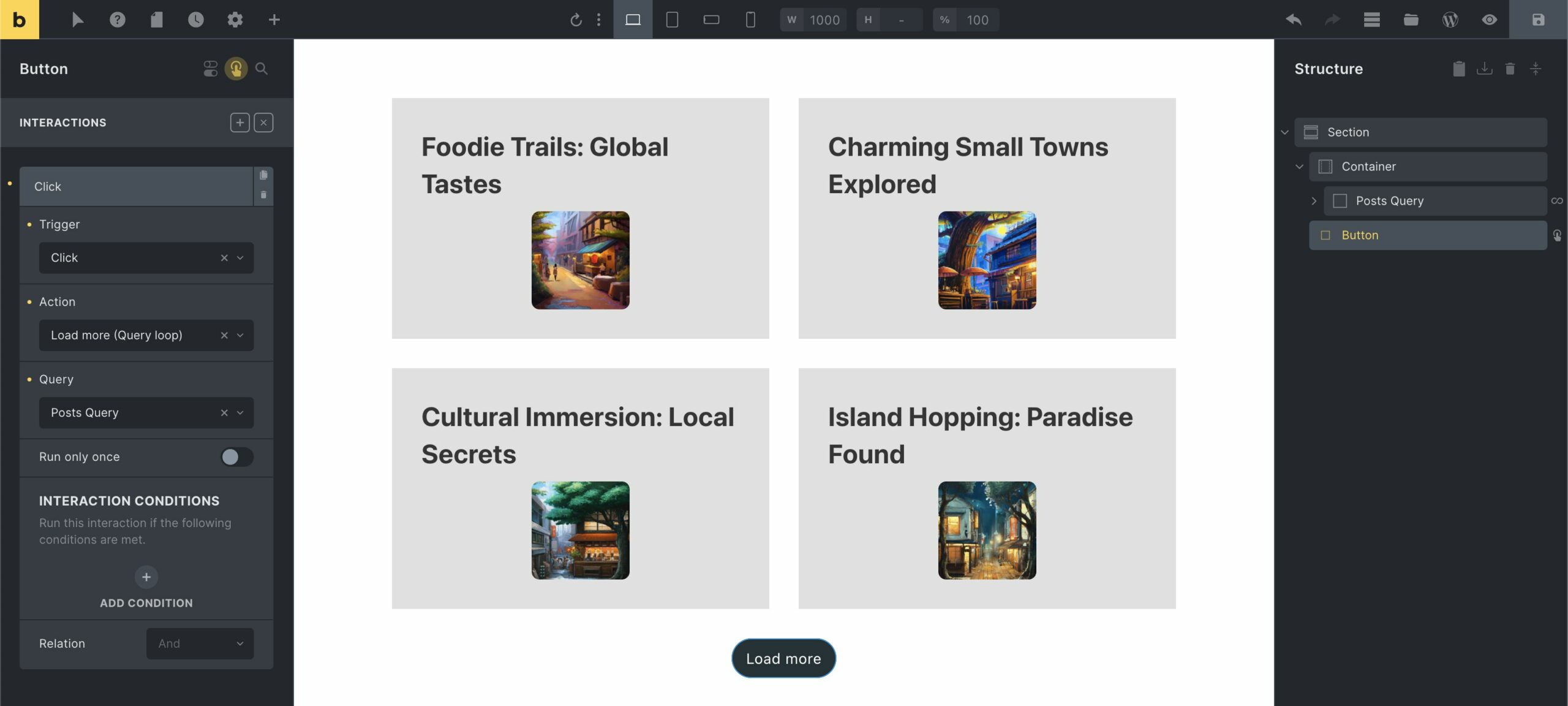
Section titled “Load more (button)”Besides the infinite scroll, which automatically loads more results as you scroll down the page, you can also give any element (typically the Button) a “Load more” functionality by adding a “Load more” click interaction to it like this:
Query IDs, Filters, and Live Search
Section titled “Query IDs, Filters, and Live Search”Each query loop is identified by the element ID of the loop element. On the frontend this is usually the six-character Bricks ID without the #brxe- prefix. If the loop element ID is #brxe-abc123, the target query ID is usually abc123.
Use that ID when you connect:
- Query Filter elements
- A Pagination element
- AJAX pagination, Load More, or Infinite Scroll behavior
- Filter-aware dynamic tags such as
{query_results_count_filter:abc123}
Query Filters and Live Search support post, term, and user query loops. They do not target API or array query loops.
For Live Search:
- Add a Filter - Search element.
- Assign it to the target query.
- Enable Live Search on the target query loop.
- Set the Live Search Wrapper Selector to the element that should show or hide the live-search results.
The wrapper selector is usually the parent element around the loop output.
Query loop in Accordions & Sliders
Section titled “Query loop in Accordions & Sliders”The classic Accordion and Slider elements also allow to pull data dynamically through the Query Loop to feed the element parts.
You’ll find a Query Loop control in the Accordion element to configure a query. The query creates as many accordion items as there are results.
You’ll be able to configure the accordion title, subtitle, and content of the “master” accordion item, and this will be used as a template for the dynamic accordion items:
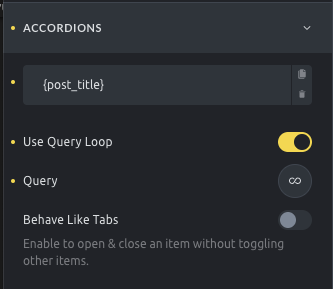
Use the query loop in the accordion element
The same happens in the Slider element. If the Query Loop is enabled, you’ll have access to a Query control and a slide item, which will behave as the template for all the slides.
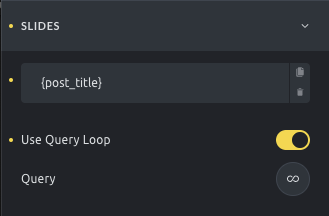
Use the query loop in the slider element.
Include/Exclude Controls: Dynamic Data Tag Support
Section titled “Include/Exclude Controls: Dynamic Data Tag Support”Starting with Bricks 1.12, the Include and Exclude post query controls support dynamic data tags.
Starting with Bricks 2.4, the Include authors and Exclude authors controls accept selected users and dynamic tags that return user IDs.
These controls let the query read IDs from dynamic values instead of only using IDs selected manually in the builder.
- Include: Adds post IDs to the
post__inparameter. - Exclude: Adds post IDs to the
post__not_inparameter. - Include authors: Adds user IDs to the
author__inparameter. - Exclude authors: Adds user IDs to the
author__not_inparameter.
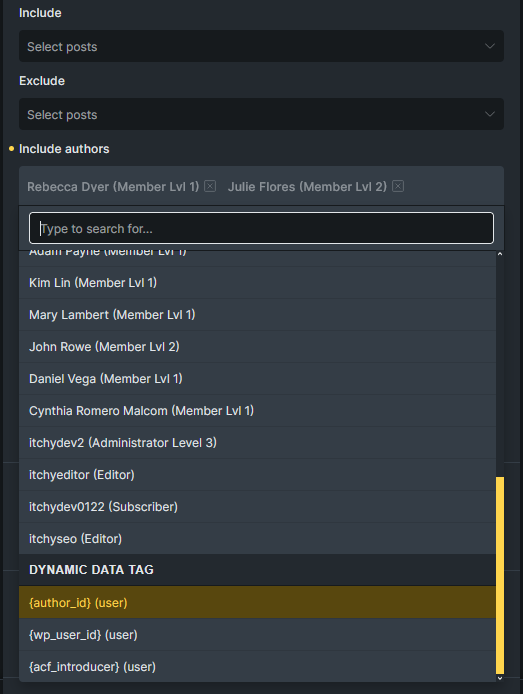
The author controls are available for Posts queries when Query editor (PHP) is turned off. Use them to show posts from selected authors, hide posts from selected authors, or match the loop to the current user or current post author.
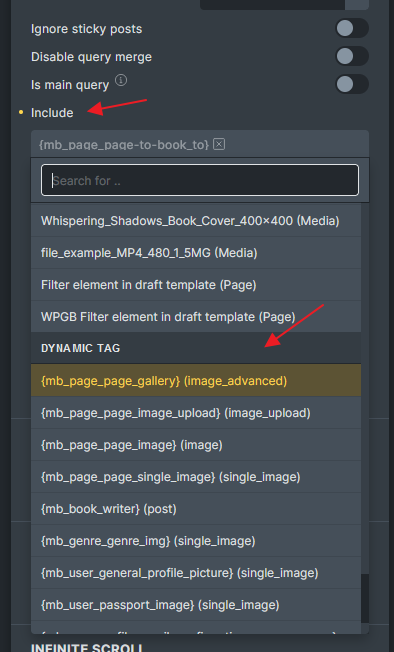
Use dynamic data in these controls when IDs are stored in a custom field or come from the current page context. The query can still use other settings, such as meta queries or taxonomy queries.
Supported Field Types
Section titled “Supported Field Types”- WordPress:
{wp_user_id}and{author_id}for author include/exclude controls - ACF: Relationship, Post Object, Gallery, User
- Meta Box: Relationship, Post, Image Advanced, Image, Image Upload, Single Image, User
- JetEngine: Relationship, Post, Gallery, Media (
@since 2.2)
For author include/exclude controls, the dynamic tag must return one or more user IDs. Bricks supports native user-related tags such as {wp_user_id} and {author_id}, plus ACF and Meta Box fields with the User field type.
When both include and exclude author rules are present, Bricks removes excluded author IDs from the include list before running the query. If no author remains after that comparison, the query returns no posts.
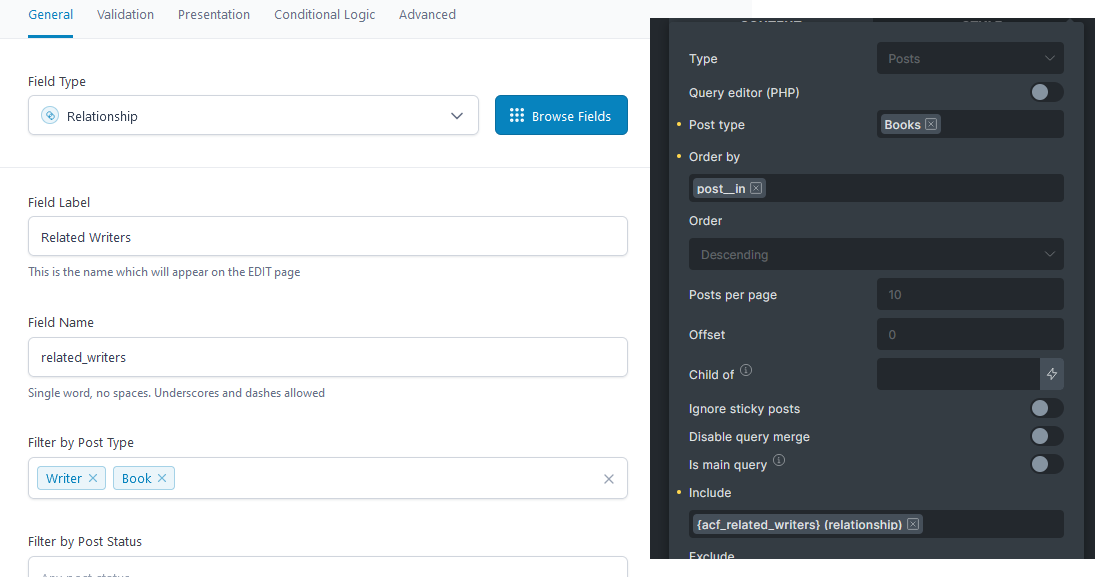
Example 1: Retrieve ACF Relationship Posts by Post Type and Order by Post IDs
Section titled “Example 1: Retrieve ACF Relationship Posts by Post Type and Order by Post IDs”For an ACF Relationship field that connects to multiple post types, you can limit the returned posts to the “Book” post type and keep the same order defined in the relationship field.
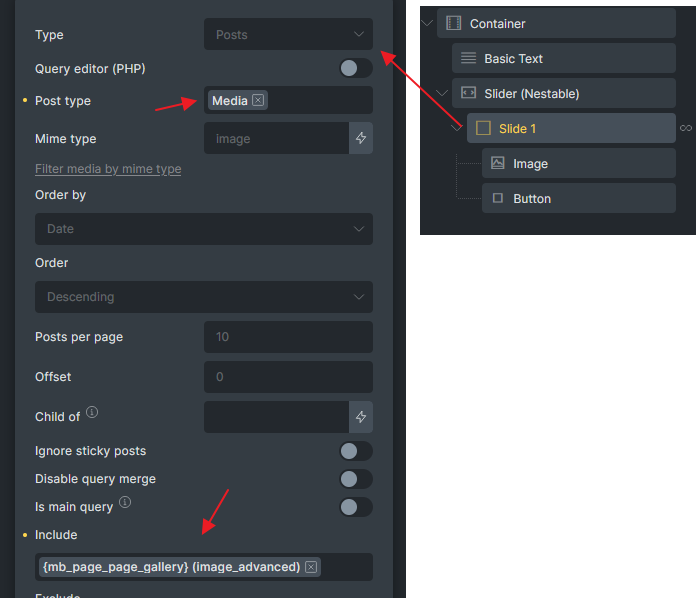
Example 2: Use Meta Box Image Advanced Field for a Slider Query Loop
Section titled “Example 2: Use Meta Box Image Advanced Field for a Slider Query Loop”Previously, retrieving images saved in the Meta Box Image Advanced field required using a PHP filter to pass the image IDs into the post__in parameter. Now, you can achieve this directly within the Query Loop UI.
Simply choose your dynamic field, set the Post Type to Media and, if needed, add an additional Mime Type filter to ensure only the correct image types are included.
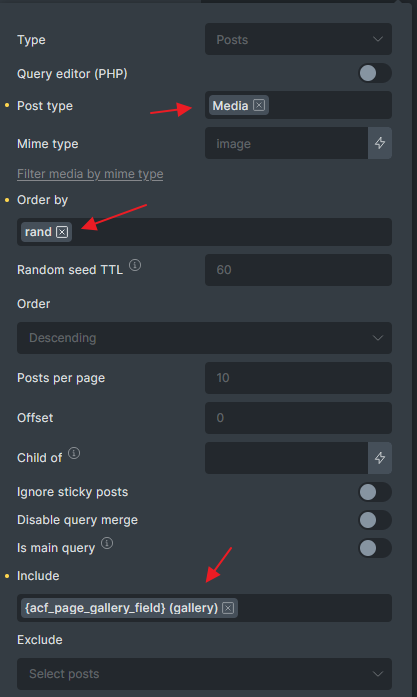
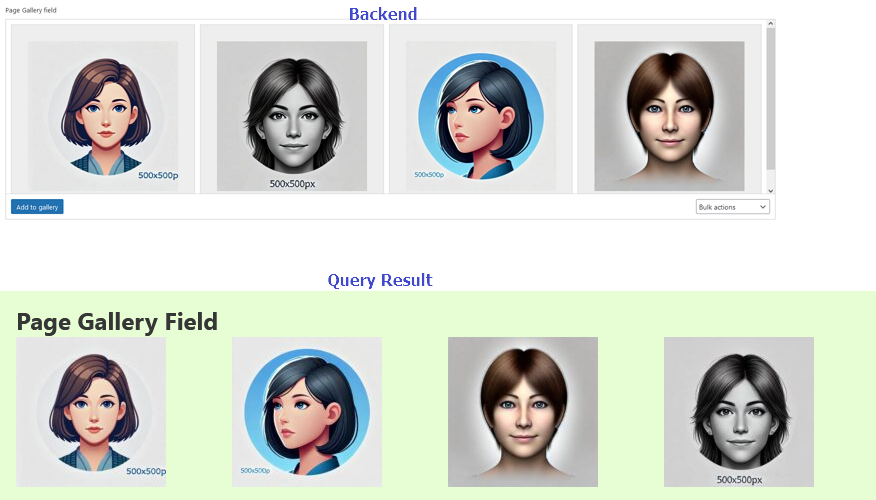
Example 3: Query ACF Gallery with Random Order
Section titled “Example 3: Query ACF Gallery with Random Order”To display images from an ACF Gallery field in a random order, set the Post Type to Media. (Add an additional Mime Type filter if necessary to ensure only specific file types are included.) Select Random (rand) to randomize the order of the images in the gallery.
Query Type: API
Section titled “Query Type: API”The API query loop type lets you render array items returned by an external JSON API. Configure the API request in the API settings popup, including the URL, method, authorization, headers, URL parameters, request body, response path, cache duration, and pagination.
Use {query_api @key:'fieldName'} inside the loop to render a field from the current API result.
For full setup details, see Query data from APIs.
Important limitations:
- API query loops do not support Query Filters.
- API query loops do not support Live Search.
- API query loops use their own API settings popup instead of the standard post, term, or user query controls.
Query Type: Array
Section titled “Query Type: Array”The Array query loop type lets you loop through any PHP or JSON array. (@since 2.2)
This is useful for:
- Rendering API response arrays. (API query loop)
- Combining data from multiple sources (e.g. posts + custom arrays).
- Displaying values returned by custom functions in loop format.
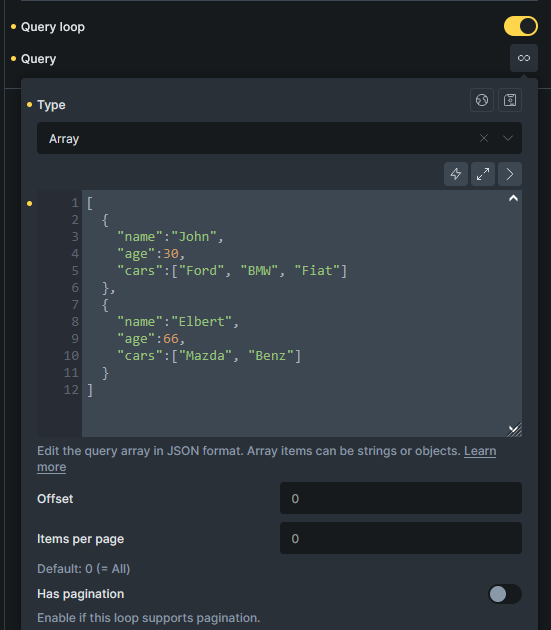
Once configured, the loop behaves like any other Bricks query: you can style each item using the builder, use dynamic tags to access values, and enable pagination features.
Supported features: AJAX/non-AJAX pagination, Load More, Infinite Scroll
Use Case 1: Looping Nested Arrays from API Responses
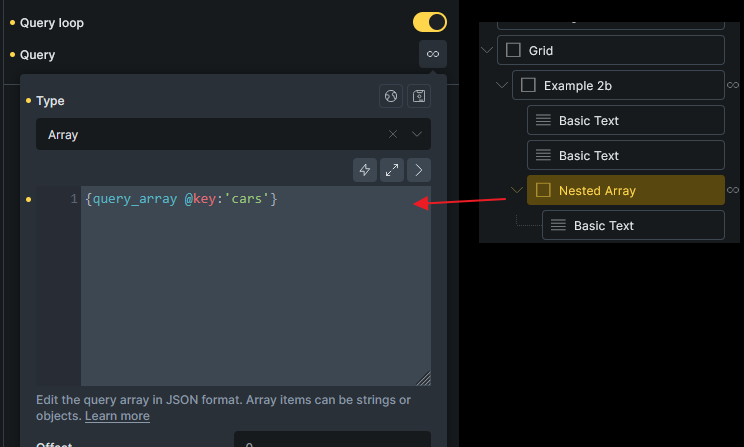
Section titled “Use Case 1: Looping Nested Arrays from API Responses”If your API response contains nested arrays (e.g. cars: ['BMW', 'Mazda']), use a nested array loop and set the correct path in the Array Editor.
Use Case 2: Looping Custom PHP Arrays
Section titled “Use Case 2: Looping Custom PHP Arrays”If you have a custom PHP function that returns an array, you can use it in the loop using a dynamic tag like {echo:my_custom_array()}.
// Ensure that my_custom_array is whitelisted via the bricks/code/echo_function_names hookfunction my_custom_array() { return [ ['name' => 'John', 'age' => 30], ['name' => 'Jane', 'age' => 25], ];}Use Case 3: Render ACF Checkbox Choices as a List
Section titled “Use Case 3: Render ACF Checkbox Choices as a List”An ACF Checkbox field returns its selected choices as an array. Use that array as the query source to render each choice as a separate list item without custom PHP.
The pattern is not limited to ACF Checkbox fields. Enter any dynamic-data tag that returns a flat array in the Array Editor. Bricks creates one loop item for each array value, and {query_array} outputs the current value inside the loop.
When you insert {acf_FIELD_NAME} directly into a text field, Bricks joins all selected choices into one string with a comma and space between each choice. There is no builder setting for this separator. Changing it requires the bricks/dynamic_data/text_separator PHP hook.
The Array query approach keeps every selected choice as a separate loop item. This gives you semantic list markup and lets you style or add content to each choice independently without changing the separator in PHP.
Use Div elements for both levels of the list. A Block uses display: flex by default, which overrides the browser’s normal ul, ol, or li display behavior and can remove list markers. A Div has no default layout styles, so the semantic list elements retain their normal display behavior.
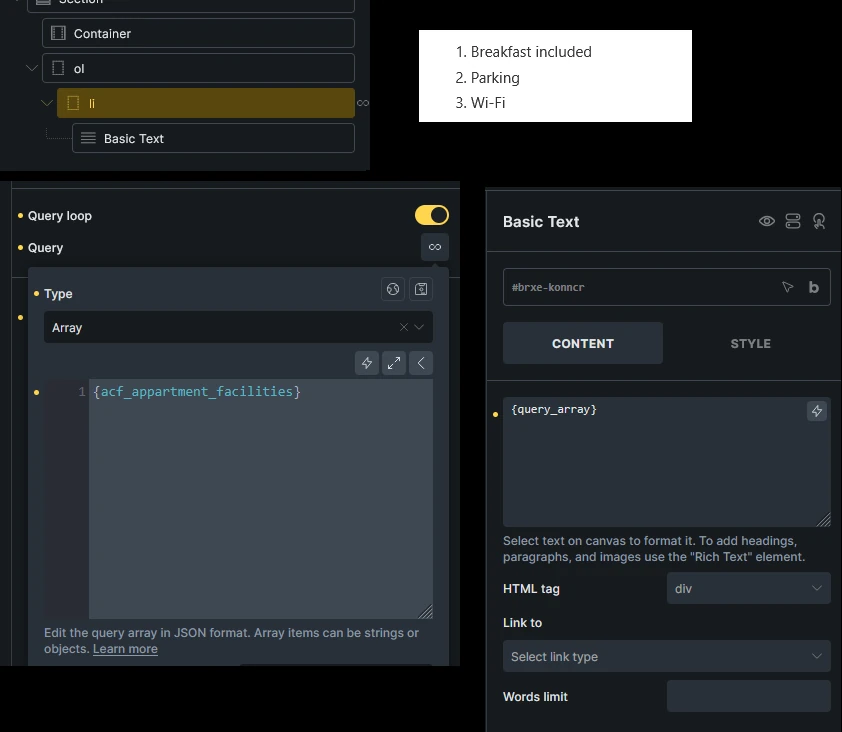
- Add a Div for the list container. Set its HTML tag to
ul, or useolwhen the order of the choices matters. Leave Use Query Loop disabled on this parent element. - Add another Div inside the list container and set its HTML tag to
li. - Enable Use Query Loop on the
lielement. Open its Query control, set Type to Array, and enter{acf_FIELD_NAME}in the Array Editor. ReplaceFIELD_NAMEwith the Checkbox field name. - Add a Basic Text element inside the
liand set its content to{query_array}.
The parent ul or ol renders once. The child li is the loop element, so Bricks repeats it for every selected checkbox choice. If the field contains “Breakfast included”, “Parking”, and “Wi-Fi”, the visible result is:
- Breakfast included
- Parking
- Wi-Fi
The ACF field’s Return Format determines what the loop receives:
- Label outputs the choice labels.
- Value outputs the stored choice values.
- Both (Array) outputs labels by default in Bricks. Use
{acf_FIELD_NAME:value}in the Array Editor when you need the stored values instead. The:valuemodifier is not needed when the field already uses the Value return format.
Use the Style tab on the parent list element for list-wide spacing and indentation. Style the looping li element to apply the same typography, spacing, background, or border to every repeated item.
For nested or associative arrays, use the {query_array @key:'keyName'} syntax described below.
Dynamic Data Tag: {query_array}
Section titled “Dynamic Data Tag: {query_array}”{query_array} - Output the current array value (array items are a simple list of strings).
{query_array @key:'age'} - Output a specific key from the array item.
Example 1: Flat List
Section titled “Example 1: Flat List”[ 'Apple', 'Banana', 'Cherry', 'Donut']Use {query_array} inside the loop to display each fruit name.
Example 2: Associative Array
Section titled “Example 2: Associative Array”[ ['name' => 'John', 'age' => 30], ['name' => 'Alan', 'age' => 25], ['name' => 'Pony', 'age' => 66]]Use {query_array @key:'name'} and {query_array @key:'age'}
Example 3: Nested Arrays
Section titled “Example 3: Nested Arrays”[ { "name": "John", "age": 30, "cars": ["Ford", "BMW", "Fiat"] }, { "name": "Elbert", "age": 66, "cars": ["Mazda", "Benz"] }]To loop through each cars array inside the main loop:
- Nest another Array Loop inside the parent loop.
- In the nested loop’s Array Editor, set:
{query_array @key:'cars'} - Use
{query_array}inside the nested loop to output each car.
Results Filter
Section titled “Results Filter”The Results Filter feature allows you to filter loop results using conditions after the array is fetched but before rendering begins. It is similar to the bricks/query/result PHP filter. (@since 2.2)
Supported Loop Types: Array, ACF Repeater
Use this feature to:
- Remove unnecessary or invalid results based on your requirement
- Prevent rendering of unwanted loop items
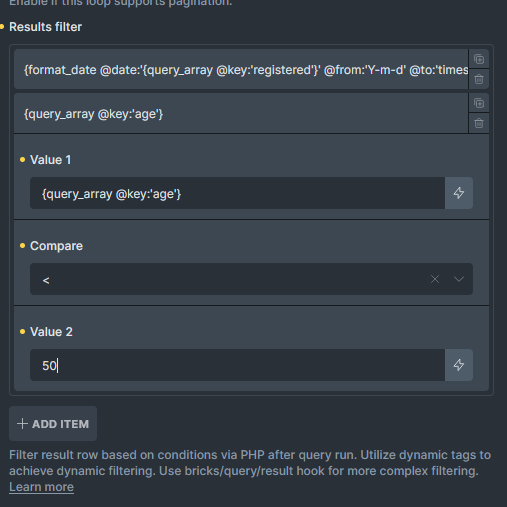
Example: Filter by Age
Section titled “Example: Filter by Age”For this array:
[ ['name' => 'John', 'age' => 30], ['name' => 'Alan', 'age' => 25], ['name' => 'Pony', 'age' => 66]]You only want to display people whose age is less than 50. You can configure a result filter like this:
| Field | Operator | Value |
|---|---|---|
{query_array @key:'age'} | < | 50 |
This filter excludes the last item (Pony, age 66) from rendering, so only John and Alan appear in the loop output.
No Results
Section titled “No Results”Each Query Loop can show fallback content when no results match the query.
You can use:
- No Results text for a short message
- A no-results template where that option is available
Bricks may still process loop child elements internally when there are no results so required scripts, styles, and popup assets can be prepared for the page. That does not mean fake loop content is shown to visitors.
Performance Guidance
Section titled “Performance Guidance”Use the smallest query that gives you the result you need.
Good defaults:
- Set a realistic Posts Per Page, Number, or Items per page value.
- Avoid
-1on large datasets. - Disable query merge on secondary loops.
- Use No Found Rows when you do not need pagination or total counts.
- Disable post meta or term cache updates only when the loop does not use that data.
- Add a stable secondary sort when paginating.
- Keep nested loops small.
Troubleshooting
Section titled “Troubleshooting”The loop shows the wrong posts on an archive
Section titled “The loop shows the wrong posts on an archive”Check whether the loop should merge with the current archive query. For the main archive listing, enable Is main query (Archive, Search) and do not disable query merge. For unrelated loops, enable Disable Query Merge.
Pagination shows a 404 on an archive
Section titled “Pagination shows a 404 on an archive”Make sure only one loop is marked as the main archive/search query, and make sure the Pagination element targets that loop.
Filters do not change the loop
Section titled “Filters do not change the loop”Check the target query ID on every filter element. Then verify that the target query type is post, term, or user.
AJAX pagination or Infinite Scroll stopped working
Section titled “AJAX pagination or Infinite Scroll stopped working”Check whether an optimization plugin is removing Bricks query loop HTML comments such as <!--brx-loop-start-abc123-->. Those comments are required markers.
Dynamic data shows the page instead of the loop item
Section titled “Dynamic data shows the page instead of the loop item”Make sure the element with the dynamic tag is inside the loop element, and make sure the tag supports the query type.
Query loop hooks
Section titled “Query loop hooks”- bricks/query/run (filter)
- bricks/terms/query_vars (filter)
- bricks/users/query_vars (filter)
- bricks/posts/merge_query (filter)
- bricks/posts/query_vars (filter)
- bricks/query/loop_object (filter)
- bricks/query/loop_object_id (filter)
- bricks/query/loop_object_type (filter)
- bricks/query/no_results_content (filter)
- bricks/query/before_loop (action)
- bricks/query/after_loop (action)
- bricks/query/result (filter)
- bricks/query/result_count (filter)
- bricks/query/result_max_num_pages (filter)
- bricks/query/init_loop_index (filter)
Was this helpful?
A quick vote and short notes help us improve these docs faster.
Leave a note for us
Please do not include passwords, license keys, or personal data. We store submitted notes to improve the docs.
Thanks for sharing feedback. We're using it to improve these docs.