
Structure Panel Search and Filters
In Bricks 2.5, search and filters help you find elements in the Structure panel without opening every branch of a large layout. Search for a button’s text, find elements using a class, or show elements with conditions or interactions.
Open the search
Section titled “Open the search”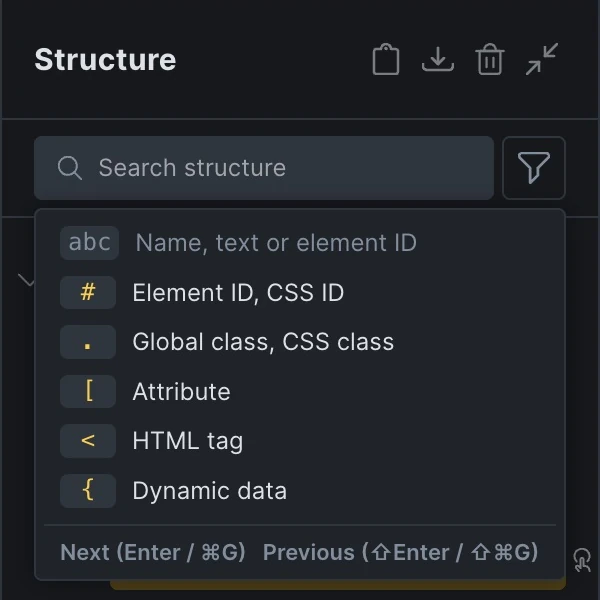
Use the Search structure field at the top of the Structure panel. It appears when the current editing context contains elements.
The default shortcut is CMD / CTRL + F. It opens the panel if hidden or minimized and focuses the search. While typing in a field, including the Structure search itself, the same shortcut keeps the browser’s normal Find behavior. It also keeps browser Find on an empty page.
You can change or disable Search structure under Manage > Keyboard shortcuts. See Keyboard Shortcuts.
Search by name or text
Section titled “Search by name or text”Type an element label, element type, or text from its content. Searches ignore capitalization and match part of the text. For example:
herofinds elements labelled Hero.headingfinds Heading elements, including ones you have renamed.get startedfinds that text in a button or another supported text field.
Text search includes fields such as accordion and tab titles, list items, pricing features, and form labels and placeholders. It searches stored text settings, not the resolved output of dynamic data or the contents of code and custom CSS.
Paste a complete Bricks element ID, such as brxe-abc123 or abc123, to find that element. Use the # prefix for a partial ID or a custom CSS ID.
Search prefixes
Section titled “Search prefixes”Start a search with one of these prefixes to choose what to search. These are search shortcuts, not full CSS selectors.
| Prefix | Searches | Example |
|---|---|---|
# | Bricks element IDs and custom CSS IDs | #hero or #brxe-abc |
. | Assigned global classes and custom CSS classes | .btn--primary |
[ | Custom attribute names or values | [aria-label or [data-track=signup |
< | HTML tags | <h2 or <h |
{ | Dynamic data tags in element settings | {post_title or {acf_ |
IDs, classes, attributes, and dynamic data tags support partial matches. HTML tag search matches from the start of the tag name: <h can find h1 through h6, but can also match another tag starting with h, such as header.
For attributes, [data-track=signup requires both the attribute name and value to match on the same attribute. With no =, the search checks either the name or value. The closing ], >, or } is optional for attribute, HTML tag, and dynamic data searches.
Use {post_title to find an element using that dynamic data tag, regardless of the title it currently displays. Tags inside code or custom CSS are excluded.
Focus the empty search field to see a prefix cheat sheet. Click a prefix to insert it, or use the arrow keys or Tab to reach a prefix button and Enter to activate it.
Classes and attributes require their prefix. If a plain search finds nothing, Search instead for may suggest a prefixed search that has results. Click the suggestion to apply it.
Read and navigate results
Section titled “Read and navigate results”Matching elements are highlighted. Their parents stay visible, dimmed and expanded, so you can see where each match sits in the layout. Other branches are hidden from the Structure panel. This does not hide elements on the frontend.
When a match comes from text, an ID, a class, a tag, or an attribute, an excerpt or value appears below the row. Hover over it to see the match type, such as Global class.
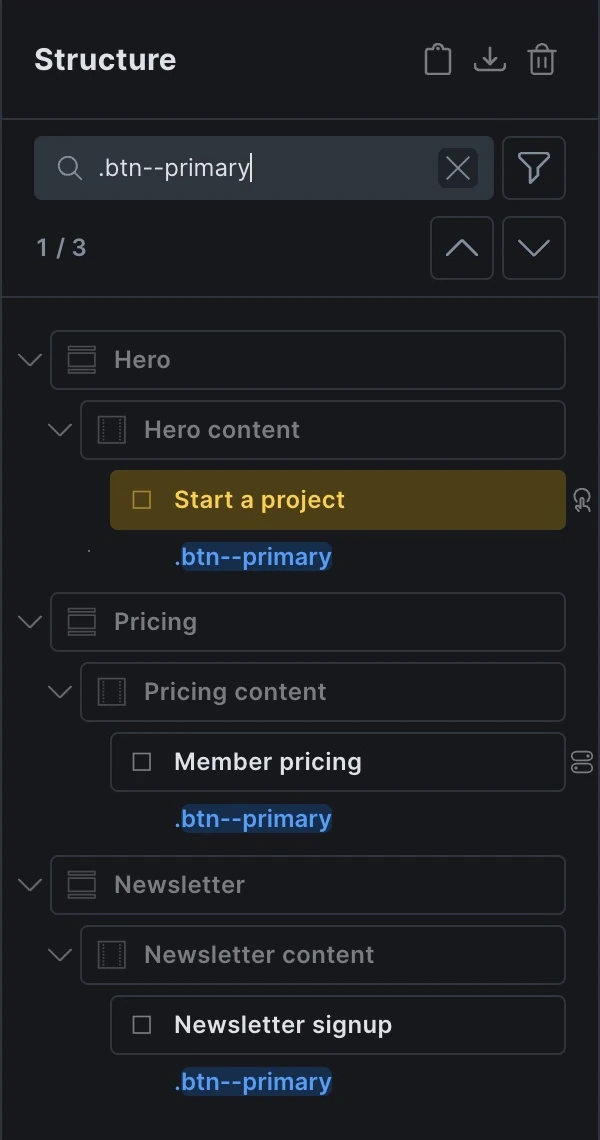
Use the previous and next buttons beside the result counter to select matches. While the search input has focus:
| Keys | Action |
|---|---|
Enter or CMD / CTRL + G | Select the next match |
Shift + Enter or CMD / CTRL + Shift + G | Select the previous match |
Esc | Clear the search text, or dismiss the open cheat sheet |
Navigation wraps from the last match to the first and keeps focus in the search input. The selected element and its parent path stay visible even if it does not match, so a visible row is not necessarily counted as a result.
Filter elements
Section titled “Filter elements”Click the funnel button beside the search field to show the filters.
| Filter | Finds |
|---|---|
| Query loop | Elements with a query loop enabled |
| Conditions | Elements with display conditions |
| Interactions | Elements with interactions |
| Custom CSS | Elements with custom CSS in their element settings, including breakpoint or pseudo-class variants |
| Hidden | Elements hidden in the builder or on the frontend, or with an element Display setting of none at any breakpoint or pseudo-class |
| Components | Component instances |
| Dynamic data | Elements with dynamic data tags in their settings, excluding code and custom CSS |
| Attributes | Elements with custom attributes |
| Code | Code elements and elements flagged as containing unsigned code |
These filters inspect element settings. Hidden does not test computed visibility, and Custom CSS does not find every element styled by a global class or stylesheet.
Select multiple filters to find elements matching any of them. When you also enter search text, an element must match the text and at least one selected filter.
For example, search .btn--primary and select Conditions and Interactions to find buttons using that class that have either conditions or interactions. This helps you locate buttons with behavior to review.
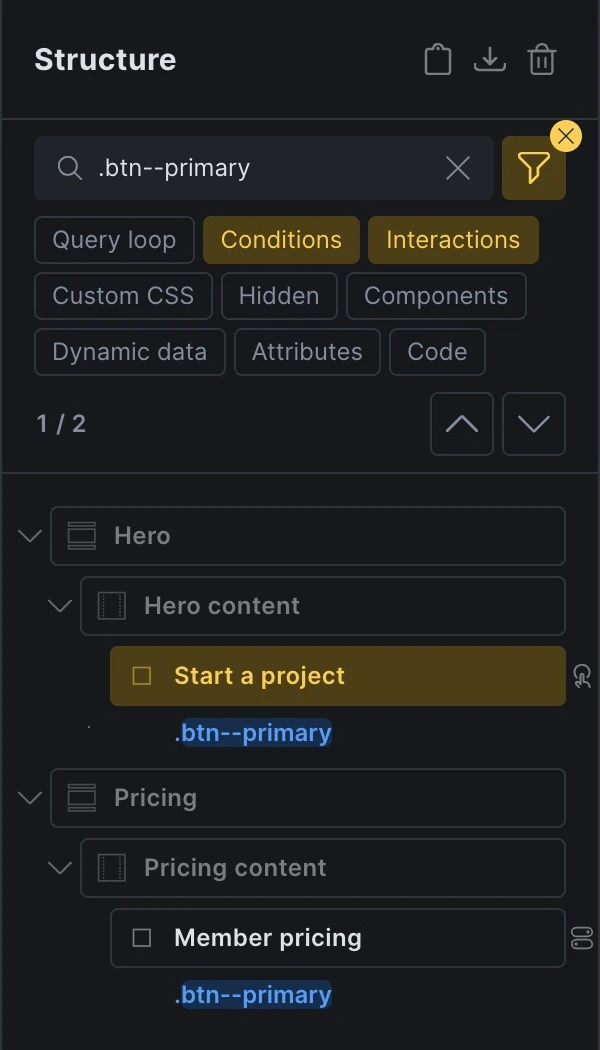
Click a selected filter to turn it off. The × badge on the funnel button clears all filters and keeps the search text. Clearing only the text keeps your filters active. If nothing matches, the Clear search button in the empty state clears both.
Return to the full structure
Section titled “Return to the full structure”Clear the search text and all filters to restore the full tree and its previous expanded and collapsed branches. Drag and drop and Expand/collapse all are unavailable while search or filters are active.
Search follows the tree for the current editing context. On a page, component instances expose their slots and assigned slot content; open the main component to search its internal elements. Search and filters reset when you enter or leave component editing or navigate to another page in the builder.
Was this helpful?
A quick vote and short notes help us improve these docs faster.
Leave a note for us
Please do not include passwords, license keys, or personal data. We store submitted notes to improve the docs.
Thanks for sharing feedback. We're using it to improve these docs.